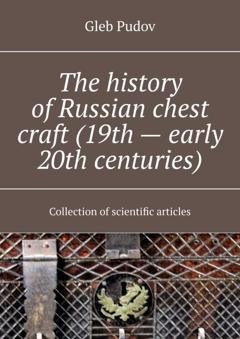
The history of Russian chest craft (19th – early 20th centuries)
Collection of scientific articles
Gleb Pudov
Reviewer Alexej Chevardin
Reviewer Irina Kolobkova
Editor Natalia Kovaleva
© Gleb Pudov, 2022
ISBN 978-5-0056-3717-8
Created with Ridero smart publishing system
Foreword
The chest has been known in Russia since ancient times. Even in the annals and Novgorod birch bark letters there are references to chests and caskets. Many of them are admirable works of art. By the 19th century, Russian chest craft had turned into a powerful industry, in which hundreds of craftsmen were employed.
The history of chest production has been little studied until recently. There were only a few scientific articles and small notes in local newspapers. However, the situation has recently changed: monographs have been published in the major centers of chest production in Russia, as well as many scientific articles, the conclusions of which are based on previously unknown archival information. These works deal with many aspects of the chest production: the history of specific workshops, branding features, the specifics of certain types of chests and caskets, biographies of people who explored the craft in the 19th century, etc. But all of them were published in Russian and are known only to a narrow circle of local specialists. For foreign researchers, the history of Russian chest production remains terra incognita. Until now, information about it has hardly gone beyond the geographical borders of Russia.
This edition is the first attempt to «cut a window to Europe». As soon as the book is available in foreign libraries, it will enable Western scholars to get acquainted with the history of the Russian chest.
Gleb Pudov summarized the experience of many years of research on chest production in Russia in his monograph. The sections of the book present and analyze the activities of various Russian centers of the production of chests in the 19th – early 20th centuries (Russian North, Urals, Murom district, Vyatka province, local centers of craft). The illustrative material makes the author’s assertions convincing.
The main conclusions of the study are substantiated by extensive historiography and a large set of sources (archival data, museum specimens and field surveys of preserved objects).
After being acquainted with this book a foreign reader will get an idea about the Russian chest industry. It will become apparent that the products of each center had differences. They were evident in the appearance of chests and caskets. In his monograph Gleb Pudov emphasizes that the masters were the bearers of the traditions that had developed in a particular region. Therefore, as a rule, the artistic design of their products coincided with the products of other handicraftsmen: manufacturers of painted trays, wooden utensils, etc. The chest makers used materials and techniques that were widespread in their region, guided by the preferences of representatives of specific social strata.
So, in the eyes of the European reader, the Russian chest can appear not only as a local artistic phenomenon, but also as part of the world arts and crafts.
Natalia M. Shabalina, Doctor of Arts, Professor, South Ural State Humanitarian-Pedagogical University (Chelyabinsk, Russia); e-mail: nat.shabalina@mail.ru
From the author
The Russian chest is a wonderful artistic phenomenon. However, it is not well studied. There are many lacunae related to one or another particular chest production.
The proposed book consists of 15 scientific articles devoted to different aspects of the chest craft. What is the peculiarity of this collection? Firstly, not all of the author’s works on the history of the production of chests were included in it, but only those characterizing any aspects of it. Secondly, the articles are arranged not according to the time of writing, but according to the chronology of the chest production in Russia and the importance of one or another center for the general history of the craft. Thirdly, it took into account where the paper was published. Preference was given to less accessible to the reader works (for example, from collections of regional museums or universities). All articles have been corrected and supplemented in accordance with the current level of knowledge of Russian chest production, some are published in abbreviations.
It is unlikely that the author managed to avoid repetitions. There is a certain range of sources on the history of the chest craft of one or another region today. Addressing them inevitably leads to repetitions of certain facts, surnames, statistical information, etc. The author expresses the hope that the reader will duly understand it.
The history of the Russian chest has not been written yet. This publication is, in a sense, a preparatory work for a large generalizing book on the history of chest production in Russia. It only outlines the main points and sets the main accents. Perhaps, this will serve as a support for future researchers.
I’m grateful to Anna Kuznetskaya, a teacher and a linguist, for the assistance.
Russian-scandinavian artistic relations in chest production
The problem of interaction of craft traditions in the production of chests1is of great importance when examining their artistic style. However, little attention has been paid to it until now. In the scientific literature, from time to time, there are only indications of the generality of the forms of Russian and foreign chest products2. As a rule, that’s as far as it, and, moreover, most often we mean Western European, not Scandinavian items.
The purpose of this article is to identify the results of the interaction of Russian and Scandinavian artistic traditions in chest production, to determine the role and significance of foreign influences on formation of Russian chest products style. The task is to analyse the artistic style, construction and materials of specific works from the collections of Russian and Scandinavian museums. While working on the topic, information from domestic and foreign special literature was used.
It should be noted that the the limitation of the length of the article does not allow considering all the issues and problems associated with this topic. It is truly inexhaustible, so the author only outlines the main points.
* * *
Russian-Scandinavian relations are among the oldest in Europe. Trade and political ties have led to interactions in the spheres of arts and architecture. In Russian-Swedish relations, cooperation in the field of metal processing and sale has acquired particular importance3. In the 1680s and 1690s, together with Russian merchants, Russian armourers, coppersmiths, and tinsmiths came to Sweden every year. The Swedes were among the masters of the Armory. They also worked at Russian ironworks production, weapons factories, glass production, and were on scientific expeditions. Diplomatic embassies played a significant role in the appearance of works of swedish applied art in Russia4. In the 18th century, relations between countries were contradictory. On the one hand, cooperation was interrupted by military conflicts, on the other, it developed especially fruitfully during periods of peace. Swedish masters of various art specialties were hired to work in Russia. At the beginning of the 18th century in St. Petersburg, swedish craftsmen ranked second after the Germans in terms of number5. According to Armin Felkerzam, up to a hundred of them arrived in St. Petersburg only before 17806. It is known that swedish joiners and carpenters took part in the construction of Peterhof. It should be especially noted that they were also among the artisans who taught Russian craftsmen their skill7. Scandinavian craftsmen played a very significant role in the history of Russian applied art in the second half of the 18th century. Swedish silversmiths can be regarded as «the guides of Western styles and Western fashions. Through them all the styles of the 18th century gradually penetrated to Russia, although with a delay of ten years»8. Not only silversmiths, but masters of other specialties were represented in the Russian capital in large numbers. There were swedish masters in other cities and villages of Russia. It is no coincidence that Vladimir Suslov in his «Travel Notes» (1888) pointed to the striking similarity between the objects of peasant life in Sweden and the Russian North. Running a little ahead, we point out that the researcher meant not only Sweden, but also Norway, and chests also appeared in his comparisons9.
Russia has active cultural and economic ties with Norway and Denmark. From the Icelandic sagas it is known that the Norwegians made trade trips to the Russian lands, mainly to Novgorod already in the X – early XII centuries. The border between states was officially recognized in 1326. Trade relations became permanent in the 16th century, the Norwegians came to Kola, Kegor, the Pechengsky monastery, Kholmogory. In the next century Arkhangelsk became the main trade center. Russian merchants also traveled to Norway, and they were not only Murmansk residents, but also dwellers of Podvinya, Kargopol, and the villages of the White Sea. The active communication led to the existence of parallels in many areas of culture, in particular, in the construction of wooden churches, woodcarving and book illustrations. For a long time, not only cultural and trade, but also political ties have been established between the countries.
Russian-Danish relations were no less ancient. The first information about the Danes is found in the Novgorod First Chronicle of the years 1130 and 1134. Nevertheless, ties between countries originated much earlier than the XII century, as evidenced by the data of numismatics and linguistics10. They reached significant development in the 15th century. The first Russian-Danish treaty was signed in 1493, which was of an anti-Swedish character. Danish merchants, in comparison with merchants of other countries, received great privileges: they could trade throughout the territory of Russia, they were given two trading yards. Even the Danish government was directly involved in trade. The economic rapprochement between Russia and Denmark had a specific reason. They wanted to get rid of the mediation of the Hansa11. The role of political partnership increased markedly in the 18th century.
So for centuries there have been strong ties between Russia and Scandinavia, including different areas of culture. The production of chest and caskets, which existed in these states for a long time, was no exception12.
Parallels can be traced already at the level of the etymology of words denoting certain chest products, as well as objects associated with them. For example, the Old Russian word «korsta» – «coffin», which has been preserved in some northern dialects, is close not only to the Germanic «kasten» («box»), which goes back to the Latin word «cista» («box»)13, but also the swedish word «kista» («chest»). The Russian word «chest» comes from the ancient Swedish «lárr» («chest», «drawer») and «lår» («box, chest»)14. According to other sources, the ancient swedish word itself could be borrowed from the Old Russian15. One way or another, the etymology of the word «chest» testifies to the existence from an early period of Russian-Swedish ties in the use of chest products, and possibly their production.
In June 2004, in Pskov, in one of the burials of the Viking Age, the remains of a wooden casket were discovered, which dates back to the 10th century16. On its round lid, between four triangular iron plates, there were bronze plates decorated in the Jelling style17. An iron ring with a diameter of 4.5 cm is attached in the middle of the lid. The lid is bordered by a rim of nails with wide heads. The lock was placed in the wall of the casket. Its analogue were found in Birka18.The considered casket testifies to one of the ways of getting Scandinavian products to Russia and their existence here since ancient times. This provided an opportunity for direct interaction between Russian and Scandinavian traditions in the production of chest and caskets. Let us consider several of their types19.
In museums of Russia there are items, which are called trunks (“baul” in Russian). They were taken along on trips. The trunks are of different sizes. Their body is cylindrical, the lid is on top, on the sides there are small curly handles. As a rule, such items were covered with the skins of sea animals, upholstered with slotted iron strips. In front there was a curly iron plate that protected the key hole. The collection of the Department of folk art of the Russian Museum contains a similar item dating from the 18th century20. Five iron strips with a cut ornamentation consisting of a row of “cucumbers”21 are attached on its oak base, in front there is a cast hinge.
Many similar items made in Sweden and called chests («kista») can be found in museums in different cities of this country, for example, in Kalmar22. As an example, we give a product at the inventory number KLM 2146623. It has a cylindrical shape and is covered with seal skin. Thin iron strips are nailed on top, wide at the edges. There is no slit ornament on them. In the middle there is a square metal plate. There is no lock. This chest has wrought iron handle on each side. The inside of the chest is upholstered with unpainted linen. Similar things were done in Denmark24.
Together with the complete similarity of the designs of Russian and Scandinavian items, there are obvious differences in decoration. The slotted ornament of Russian chests consists of ornamental figures borrowed from oriental fabrics that came to Russia in abundance in the 17th century. There is no cut ornament on swedish items (with the exception of a few dates included in the strips; these can be considered as a kind of decoration). The ornamentation is focused on wide strips that are placed along the edges of the items: they are given a wave-like shape25.
Another striking example is the so-called “podgolovnik”. There is a “podgolovnik” in the collection of Department of folk art26, manufactured in 1750. This item is of considerable size (34x55x42), the outer surfaces of which are upholstered with leather and smooth iron strips, located “in a cage”. Inside each “cell” there are slotted rosettes with mica lining. In the corners of the lid and the top wall there are slotted strips in the form of triangles. On the face of the lock, in a zigzag frame, the inscription is engraved: “1750 September 23rd day of srk ivan chyupyatov”. There are forged handles on the side walls. Inside “podgolovnik” there are twelve compartments, eight of which are with drawers. The podgolovnik, probably of Kholmogory origin, is notable for its durability, solidity and reliability. The symmetry of the ornament, its clarity, “calculated” contribute to this impression. The main thing for the master was the direct purpose of the product as a repository of valuable things and documents. The general artistic solution of the podgolovnik is characterized by masculine roughness, severity, against the background of which all the ornamental delights look like optional additions.
Norwegian «podgolovnik»27 dates back to 1751. It has a similar design, but slightly different proportions (actually another wall serves as its base). The lid rises with iron curly hinges, on the sides there are simple cast handles. The chest has several shelves from the inside (not preserved). The surfaces of the product (except for the back and side ones) are divided into rectangular segments, in each of which there is a picturesque composition consisting of images of bouquets framed blue. They are painted in the fast, improvised manner of Norwegian wood painting. The rest of the surfaces are painted red. On the edges of the lid there are inscriptions in white paint: «Ek Ols Domis (?) Ann 1751». Perhaps this item served as a travel chest for some official.
Of particular note are products of other proportions, in their shape resembling a chest of drawers, in other words, these are podgolovniks placed on the back wall. The collection of The Department of folk art contains such a “chest of drawers” (dates back to the 18th century)28. Its front and side walls are upholstered with slotted iron plates with a floral ornament consisting of intertwining curls (background is brown velvet). The bottom and back side are reinforced with solid iron plates. There are several shelves and drawers inside the product, the lower part can be pulled out.
Norwegian products of this type (for example, items from the collection of the Vasa Museum29) have identical proportions, structure, they also use a combination of wood and iron. But they are almost devoid of ornaments, their main characteristics are reliability and durability.
Comparing all these items made their differences clear. They are similar only in design and shape, in all other respects they are different. This is due to the fact that chests called «podgolovnik» were made in different historical and cultural settings for different customers. The shape and design of this type of products have undergone changes not depending on the place and time of production, but the purpose and decoration.
Mention should also be made of caskets. One of their types, which must be addressed, are things of a rectangular shape, upholstered with stripes of checked pattern and equipped with curly slit overlays. Russian products of this kind were traditional products of the masters of Veliky Ustyug. For example, a box from The Department of folk art of the State Russian Museum30 was made by master Plisov in 1834. It has rounded corners and a slightly convex lid. On the sides there are two forged handles. The box is painted with light green paint and upholstered with checked iron strips. On the front and back walls there are three slotted masks with figured leaves in the center (the middle one is the largest). In the center of the lid there is a slotted plate with a flap, in the corners there are slotted plates of the same type. There is a pattern of rounded curls on a foil background. The inscription on the lock says “City of Ustyug master Plisov 1834”.
It is appropriate to name another box from the same collection (dates back to the 19th century)31. It is rectangular and has a flat lid. All surfaces are upholstered with thin checked metal strips, under which blue velvet is placed. In the corners of the lid there are square slotted plates with floral ornaments, in the center there is a round plate. A similar ornament, consisting of intertwining curls, adorns the mask. The lid has a staple handle and a ring. Many items of this kind were done in Ustyug, as evidenced not only by the collection of the Department of folk art, but also by other museums32.
In the collection of the Museum of the city of Kalmar there is a similar box, which dates back to the 17th century33. It is rectangular in shape, the lid is slightly convex and the corners are rounded. The box is upholstered with checked iron strips. A handle is attached to the lid, at the corners of the lid there are slotted plates with an ornament resembling a clover leaf (under them there are colored lining). On the front side there are three locks with figured faces, the middle one being larger than the lateral ones. From the inside, the box is upholstered with green cloth. The inner edges of the walls are colored green.
Despite the similarity of design, decoration technique and general artistic solution, there are fundamental differences in the style of the works. The boxes vary in content. If the first one is directly related to traditional art, then the second one is belonging to «high» professional art, it is within the framework of the dominant artistic style. The inner essence of the first item is the fabulousness, cheerfulness of folk art, which makes it akin to the paintings of the Russian North, the second is the striving for monarchical solemnity and grandeur.
Another type of box, widespread in Russia and Scandinavia, were small items with a sloping lid. They were usually used while traveling. The traditional principle of covering a wooden base with another material is realized in a box from the collection of the Russian Museum34. In this case it is figured tin strips and mica. The pattern of stripes framing the lid and walls is made in the form of a wavy garland of curls with trefoils between two ribbed strips. On the lid and on the front wall there are two identical corrugated strips. There are pictures cut out of paper with images of everyday scenes under the mica. Inside the box is pasted over with green paper with a floral pattern. The artistic solution of the thing has a bright, decorative character. It should be noted that many things were decorated in a similar way in Russia in the 17th – 18th centuries, for example, outdoor lamps. Casket from the Kalmar Museum35 is much larger than Russian in size, but has the same proportions (dates back to the 17th century). It is covered with leather and upholstered with five iron cut strips. On the front side there is a figured face and an internal lock. On the sides there are small forged handles. From the inside, the box is upholstered with coarse fabric. As in the previous case, despite the similarity of forms and proportions, the works differ significantly from each other in essence. The first product is in the context of the development of Russian applied art of the 17th – 18th centuries and reflects the Russian understanding of decorativeness with its multicolor, brilliance, combinations of various materials, and an apparent preference for geometric floral ornaments. The second box in its artistic solution is close to the Swedish chests of the same period, it has little in common with a similar Russian thing in terms of decoration.
Examples of coincidences of the forms of Russian and Scandinavian chest products can be continued. For example, the so-called «sarcophagus» chests, common almost throughout Europe, remained outside the scope of the article36. They were also made in Russia37 and in Scandinavian countries38. Without going into a detailed comparison, it should be noted that things are similar in design, but differ in proportions and wall thickness.
It is necessary to briefly touch upon the topic of materials and techniques used by Russian and Scandinavian craftsmen. Both of them used wood (usually oak and pine), iron, leather, skins of sea animals39, objects were often upholstered with fabrics from the inside. However, on Russian products, unlike Scandinavian ones, mica is found. Both in Russia and in Scandinavia, forging, casting, slotting, engraving, and similar methods of joining the wooden parts of chest products were used. At the same time, the Scandinavians never turned to techniques similar to those adopted in Russia: «frozen» tin, chromolithography on tin sheets40, polished iron41.
The parallels between Russian and Scandinavian products are not accidental, which is also recognized by specialists from Scandinavia42. On some types of chest products, there is observed a close intertwining of artistic traditions that it is sometimes difficult to distinguish Russian items from Scandinavian ones. The analysis of works leads to the conclusion that in the chest production of Russia and Scandinavia there was not just a process of mutual influence, but the related artistic thinking of the masters.
Anyway, it is not worth putting an equal sign between them: despite of the similarity of designs, sizes and purposes, there are differences between Russian and Scandinavian products. They were made in different artistic environments and they are fruits of different cultures.
In this context, the question of influences loses its acuteness. It doesn’t matter who influenced whom. It is only necessary to state that both Russian and Scandinavian artisans were participants of the pan-European cultural process. Therefore, it is more important not to register certain influences, but to analyze the environment, conditions, circumstances that ensured the penetration of creative impulses. The kinship is often a consequence of the commonality of motives and plots common in the art of different countries, as well as the similarity of production methods, the use of the same sources. It is also necessary to take into account the stage-by-stage correspondence in the development of different cultures. According to sensible words by Tatyana Passek, the similarity does not mean anything until the «genetic history» of a particular ornamental scheme is traced, i.e. «Work cannot be carried out without a „paleontological“ analysis, without the use of a genetic approach to phenomena, as to natural stage-by-stage formulations of a single process of society development»43.
* * *
Three points should be noted as a conclusion.
1. The presence of parallels in Russian and Scandinavian chest production is natural. This is a consequence of centuries-old cultural ties between Russia, on the one hand, and Sweden, Norway and Denmark, on the other. The production of chests is part of a deep and extensive cultural exchange that has existed between these countries since ancient times.
2. Despite of the obvious analogies, Russian and Scandinavian chests have their own artistic style, since they were created on different cultural grounds.
3. A comparative study of Russian and Scandinavian chest products is of particular relevance. Only one aspect needs to be pointed out. Just as researchers of wooden architecture suggest using ancient Scandinavian buildings to reconstruct the external appearance of Old Russia44, with regard to the production of chest and boxes, the same can be proposed.
Russian chests called «podgolovnik»: artistic style and cultural-historical context
Among Russian chest products, “podgolovniks” occupy a significant place, both in quality and quantity. Many of these items have been preserved in museum collections (they are presented in almost all the capital’s museums, and are often found in provincial ones, especially in the Russian North45). This fact makes it easier to study this type of chest products, especially since there is a need to its research.
As a rule, independent scientific work is not devoted to certain types of Russian chest products. Most often, chests are considered in general reviews of museum collections or in articles related to certain problems of Russian chest production46. Russian chests called «podgolovnik» were no exception: as an independent type of chest products, they received almost no attention.
The purpose of this paper is to identify the design and artistic features of chests-“podgolovniks”, to determine their place in the European history of chest production. The main tasks include: clarification of the role of external influences that took place in the process of the appearance of “podgolovnik” in Russia and the gradual formation of their artistic style, analysis of specific works. The research timeframe is XVI – XIX centuries.
While working on the article, information from special literature, both foreign and Russian, was used. Numerous items from domestic and foreign museums served as the research material.
It should be noted that only preliminary conclusions are currently possible on this topic. Further additions and adjustments are not excluded.
* * *
By the definition of Pavel Savvaitov, «podgolovnik is a low chest or casket with an inclined lid, bound with iron, with an internal lock and with pulling out drawers for the jewels»47.
One of the earliest mentions of the word «podgolovnik» occurs in 1574 in the Book of the Volokolamsk monastery parish48. In the census of things by the archbishop of Kholmogory and Vazhsky Athanasius in 1702, a lot of chests are indicated, and among them «red leather podgolovnik is bound with carved tin-plated iron» in which money was kept49. The «podgolovnik» is mentioned among the purchases of Catherine I in 172250.
The «podgolovnik» is an object made of wood, most often oak. It is shaped like a box with a beveled lid. As a rule, the lid consists of two parts, which are connected by hinges: a narrow one, located parallel to the bottom, and a wide, inclined one. The proportions of the podgolovniks were not the same. They ranged from very exquisite pieces to massive large chests. From the inside, the chests were divided by wooden plates into several compartments (their number is not strictly defined), often boxes were hung on the inner walls, equipped with an additional system of locks51. There are metal handles on the side walls of the podgolovniks. Products were upholstered with iron strips, either openwork or solid. Mica or green (sometimes red or of both colours) cloth was placed under them. A shaped iron plate protected the key hole. It was often decorated with engraving. Among the slotted metal ornament, sometimes there are inscriptions indicating the year of creation of the thing and the master (or owner)52. On the inside of the lid or on the walls of the northern items, you can find a painting53. In the description of the property of the boyar Fyodor Shaklovity (XVII century) it is stated: «… Kolmogorsky podgolovnik, painted in gold, upholstered with white slotted iron…»54.
It should be noted that the decoration of the «podgolovnik» was different. In most cases, it depended on the customer. There are both richly decorated items, and very modest in an artistic sense.
The «podgolovnik» served to store documents, valuables, money, letters, and they were placed under the traveler’s head on the way (this is considered an explanation of the name of this type of chests). The member of the Swedish embassy Iohann Keelburger wrote: «Podgolovniks are not made to be written on, because they are upholstered with various tinned iron hoops; Russians, on the other hand, write both in colleges and elsewhere, never except on their knees; but such podgolovniks are made for travelers for winter period and are very convenient for laying under the head in a sleigh, because it is known that they tend to put almost a bed in Russian sleighs». However, this purpose of the podgolovniks was not the only one. There are cases when they were the subject of equipment for hunters and were taken on the hunt.
Podgolovniks were common in all strata of the population: they were found in peasant huts, in the houses of the townspeople, and in the chambers of the highest nobility, and in the royal mansions55. Such items have been made for a long time not only in the Russian North, but also in other regions of the country.
It is often stated that «podgolovnik» is a typical Russian product56. This is not entirely true. A similar form of chests existed in many European countries (although the purpose of the items was sometimes different). Let us consider Russian «podgolovnik» against the background of foreign works.
In the collection of the department of folk art of the Russian Museum there is a «podgolovnik»57, manufactured in 1750. It is of big size (34x55x42), the outer surfaces are upholstered with leather and smooth iron strips arranged as a grid. Inside each «cell» there are slotted rosettes with mica lining. In the corners of the lid and the top wall there are slotted strips in the form of triangles. On the face of the castle, in a zigzag frame, the inscription is engraved: «1750 September 23rd day of srk ivan chyupyatov». On the side walls there are curly handles. Inside «podgolovnik» there are twelve compartments, eight of which are with drawers. The «podgolovnik», which is probably of Kholmogory origin, is notable for its solidity and reliability. The symmetry of the ornament, its clarity, contribute to this impression. The main intention of the master was the direct purpose of the product as a repository of valuable items and documents. The general artistic solution of this chest is characterized by masculine roughness, severity, against the background of which all ornamental delights look like optional additions58.
There is an interesting «podgolovnik» of small size (14.5x16.0x9.5) in the collection of the Sergiev Posad Museum Reserve59. According to museum attribution, it was made in the 18th century in the village Pavlovo, Gorbatovsky district. The item is made of oak, tinted, bound with solid iron strips, between which there are four metal openwork plates (on the lid). The latter resemble a human figure with arms spread out to the sides. Under the pads there are pieces of red mica. There is a mortise lock on the front wall of the chest, and molded handles on the sides. The article in question is interesting not only as evidence of the widespread use of chests (they were made not only in the Russian North), but also as an illustration of their rich artistic potential. In contrast to the work from the department of folk art, the chest of the Sergiev Posad Museum Reserve is distinguished by its special privacy, even being like a toy, a kind of coziness in its external look.
English product («desk box», in a private collection)60 is similar to the Russians’ in design and form. But other aspects are significantly different. The item is decorated with skillfully made carvings, consisting of images of dragons, rosettes, tulips-like flowers. The cover is flat. The product was used for writing61. The clarity, compositional balance of the ornament, confidently carved images testify to the experience of the master, his high professionalism.
Another english product (dated 1580—1620) which is now in the collection of the Victoria and Albert Museum62 is also interesting. It is made of oak inlaid with boxwood and bog oak (eight drawers inside are made of poplar). The upper part and the hinged lid of the product are decorated with strips of checkerboard ornament. Images of buildings in the style of decorative motifs adopted on «nonsuch» chests are placed on the front, back and side walls. Each side also has an inlaid image of an eight-pointed star. There is a metal mask on the front wall. This «podgolovnik» has different proportions compared to the previous one (it also served as a writing instrument). It testifies to the stability and «flexibility» of the form of this type of english chest products, to the variety of their decoration. English craftsmen in the 19th century made such items, decorated not only with mosaics from multi-colored pieces of wood, but also with patterns borrowed from «Berlin» woolen products63.
German products («Geldwechsler-Schatulle», «Reise-Schreibpult») are similar to Russian and english in appearance64. Their internal cavities are separated by boxes and shelves. Various techniques were used in the decoration. The craftsmen of the items under consideration, made in the 18th century from walnut, maple, birch and oak, turned to intarsia, painting and coloring. The decorative design of the products is based on a combination of geometric and floral motifs. A painted glass plate is placed in the center. There are brass handles and covers. In general, these are highly artistic works of the German Baroque, created by professional craftsmen. «Podgolovnik» served as a place for keeping money of the money changer and a traveller’s writing instrument.
Norwegian «podgolovnik»65 dates back to 1751. It has the same construction as other things of this kind, but slightly different proportions. The lid rises with iron curly hinges, on the sides there are simple cast handles. From the inside, the chest has several shelves (not preserved). The surfaces of the product (except for the back and side ones) are divided into rectangular segments, in each of which, in a blue frame, there is a pictorial composition consisting of images of bouquets. They are painted in the fast, improvised manner of Norwegian wood painting. The rest of the surfaces are painted red. On the edges of the lid there are inscriptions in white paint: «Ek Ols Domis (?) Ann 1751». Perhaps the thing served as a travel chest for the official.
The English product is particularly noteworthy. It has other proportions, in its shape resembling a chest of drawers66. It has a smooth slanted cover; the front and side walls are decorated with geometric and floral designs (low relief). The background is processed with shading. The lower half of the product slides out. The work is characterized by clarity, confidence in the work of the carver, and the easily readable ornament testifies to the rich experience of the master.
In the collection of the department of folk art of the Russian Museum there is a chest, in proportions resembling a chest of drawers (dates back to the 18th century)67. Its front and side walls are upholstered with slotted iron plates with a floral ornament consisting of intertwining curls (background is brown velvet). The bottom and back side are reinforced with solid iron plates. There are several shelves and drawers inside the product, the lower part can be pulled out.
Such a parallel between the north Russian and english works is not accidental, in view of the close trade ties that were established between Russia and England through the northern ports in the middle of the 16th century68. It is possible that the very type of chest product, called «podgolovnik» in Russia, penetrated from Western Europe precisely through the cities of the Russian North. Moreover, such cases are known in relation to other types of Russian folk art. The researcher of folk art Lev Dinces wrote about the European origin of the so-called «Vologda glass» (embroidery), which penetrated into Russia through english merchants who traded in Arkhangelsk69. In other words, the introduction of «podgolovnik» into Russia was probably the result of a brief flourishing of Russian-English relations in the 16th century.
Comparison of all these items made their differences clear. As mentioned above, they are similar only in design and shape, in all other respects they are different. This is because chests were made in different historical and cultural settings for different customers. Russian masters, having appreciated the merits of foreign works, their convenient, practical forms, adopted only the construction70. «Transplanted» in the Russian «soil», the Russian product acquired significant differences from the «originals», naturally became part of a number of domestic products. Thus, not the shape and design of this type of product has undergone changes depending on the place and time of production, but the purpose and decoration.
In this context, the question of influences loses its acuteness. It is only necessary to state that Russian and Western European artisans were participants of a single cultural process. Therefore, it is more important not to register certain influences, not to look for similarities in specific details, but to analyze the environment, conditions, circumstances that ensured the fusion of creative impulses.
It is important to point out the term «hidden existence», which is used in folklore studies to denote some of the features of the existence of works. It seems that the acceptance or rejection of certain forms and ornaments by the artisans of chests also depended on their «hidden existence» in the local tradition. Only forms of products and ornamental motifs similar to those coming from outside took root. The researcher of Russian folklore Yu. Smirnov pointed out: «… what is borrowed is what corresponds either – less often – to the old, dying ones, or – more often – to the new, emerging, norms of the borrowing folk tradition. Consequently, when stating a borrowing, one should always look for local, actually ethnic, behind it or next to it, whether it is only traces, pieces and fragments of the forgotten»71. These words are true not only in relation to folklore, but also to chest production.
Published: Русские сундуки-подголовники: художественный стиль и культурно-исторический контекст // Вестник культуры и искусств. – 2020. – №2 (62). – С. 71—77.
The chest images in painting
From the dawn of time, the chest has been used to store valuables, documents, and food supplies. It played a special role in the wedding ceremony. It is not surprising that from an early time the chest was reflected in the works of fine arts.
In the scientific literature, this topic has not received sufficient coverage, although in some works there are references to the image of certain chests and caskets in paintings, book miniatures, frescoes, icon painting72. Researchers most often only state the fact of the image of certain chest products. Perhaps the most thorough research in this area belongs to the german researcher Paul Schubring73. His work, however, deals only with italian cassones (wedding chests).
This paper attempts to summarize information on this topic, trace the features of the image of chest products in the works of easel and monumental painting, book graphics.
It should be emphasized that the author involved only the most demonstrative works of art. The number of images of chests and caskets is truly limitless, it is impossible to cover everything in one review.
I
As early as in the painting of antique vases one can see chests and caskets with flat or sloping lids, each of which consists of four pillars and walls made of several planks. Sometimes the products are depicted in such detail that not only the design differs, but also the colors and ornamental motifs. These items were used in religious ceremonies and as home furniture. As an example antique vases from the Hermitage collection can be indicated74. Based on these drawings, we can conclude that the oldest design used to create furniture in ancient Egypt has retained its popularity.
Images of chests and caskets in Italian Renaissance art are most common. Some of them are made very carefully, so they are used as historical sources. A fresco by Giotto from the Scrovegni Chapel in Padua (1304—1306; in the scene of the Annunciation to St. Anne) shows a large red chest with a flat lid and straight walls. It is upholstered with thin iron strips, on the front side there is a figured metal plate protecting the lock. According to Italian tradition, the chest is in the bedroom. In this case, we can name two works by the Sienese artist Sano di Pietro. The first is The Nativity of the Virgin (1448—1452), in which cassone chests stand along the beds75. The front side of each of them is decorated with a painted floral ornament against a gold background, located in three rectangular figures. Since the lids on the chests are flat, the latter are used as benches. In another work by Sano di Pietro, The Birth and Naming of John the Baptist (1450—60)76 cassons are also located along the beds. Unlike the chests depicted on the previous canvas, they are devoid of painting. Their only decoration is profiled panels. Antonello da Messina on the canvas «Saint Jerome at work» (around1475)77 depicted a small chest with a flat lid and carved legs, reminiscent of Stollenrtuhe (one of the common types of chests). It is locatecd to the right of the saint. The item is devoid of any decorations, it is simple and elegant. And in the famous painting by Titian «Venus of Urbino» (1538)78 two chests are shown in the background. They have rounded walls and are decorate perhaps with intarsia. The ornament consists of whimsically twisting vegetative scrolls and anthropomorphic images. Even on the front panels of the chests themselves, wedding cassones were depicted, as, for example, on a Florentine work of the 15th century from the collection of the State Hermitage79. Two servants on a donkey carry richly decorated chests with sloping lids. Their sizes do not correspond to the real ones. Examples of the image of Italian chests on frescoes, canvases and panels can be listed almost endlessly. Thus, based on the images examined, it can be concluded that chest production has developed significantly: in the 15th century in Italy, various designs and techniques for decorating products were used.
Painters of other countries also paid attention to chest items. On the triptych of Pieter Aartsen «Adoration of the Magi» (1560)80 a large chest is depicted in some detail. It has a sloping lid reinforced with thin wooden strips from the inside; walls are straight, upholstered with iron strips, on the sides there are handles and terer are no legs. The chest may have been upholstered with leather having an ornament made in the embossing technique. And on the canvas of Hieronymus Bosch «Death of a Merchant» (1485—1490)81 even more detailed than the thing discussed above, a chest is depicted, reproducing the design of tuugkist («sarcophagus») chests. In the grooves of the four «pillars» the boards are strengthened (they also form the legs) that make up the walls. The lid is flat, it was raised and lowered with the help of wooden hinges. The front side of the chest (lower part) is decorated with geometric motifs performed in carving technique. Attention is drawn to the powerful iron plate that protects the key hole. It consists of two parts of different shapes (triangular and round), superimposed on each other. A long iron hinge is attached to the lid. The title is on the left. An interesting detail shows how the lid was held up: a dagger was used. In German painting, images of chest products are no less common. They can be seen, for example, on Stefan Lochner’s Altar of the Cologne City Cartridge (after 1426), on his own painting Madonna in the Gazebo (1440), on the left wing of the Isenheim Altarpiece by Matthias Grunewald (1506—1515). There is a chest with flat lids and walls, consisting of paneled panels; a chest with a flat lid, the walls of which are connected «in a dovetail»; richly decorated casket with a gable lid. The desire of German painters for a reliable depiction of objects (which is called by researchers as one of the features of German Renaissance painting82) made it possible to consider their canvases as a source of the history of everyday life.
The collection of the Cleveland Museum of Art contains a portrait of Sir Anthony Mildmay (around 1590—1593) by the English painter Nicholas Hilliard (around 1547—1619)83. To the right of the person being portrayed there is a large black chest with a sloping lid, upholstered with iron strips arranged as a checked one. On the front side there are three figured iron hinges. Among the furnishings of the tent of an English aristocrat, the chest occupies one of the main places.
By the 18th—19th centuries, when chests gradually fell into disuse in the higher social strata, their appearance changed. Like the other changes mentioned above, this was also reflected in painting. An idea of such chests can be given by numerous canvases and drawings by the famous Norwegian artist Adolf Tidemand (1814—1876), stored in the National Museum of Art, architecture and design (Oslo). For example, on the «The old pantry in Vik» (1867)84 four large peasant chests are depicted. They are decorated with paintings (this is the traditional Norwegian «rosemåling») and iron figured strips. They have sloping lids and high carved plinths. Similar products are kept in many museums in Scandinavia.
If we are talking about the countries of Eastern Europe, then it is necessary to mention the altar image «The adoration of the Magi» (1514) from the Peter and Paul Church of the village of Drysviaty, Braslav district, Vitebsk region85. One of the characters is holding a wooden casket upholstered with figured iron strips. The casket is depicted in great detail, the master obviously had some kind of sample before his eyes. The walls of the product are decorated with carved ornaments, consisting of floral scrolls and plot scenes. The gable cover is devoid of decorations. This image can serve as reliable evidence of the early acquaintance of Belarusian craftsmen with European products.
Another type of art, where images of chests and caskets are found, was engraving. Especially often German, Dutch and French artists and engravers turned to this plot. On the engraving of Albrecht Dürer «Saint Jerome» (1511)86 among the many furnishings of the cell there is a small chest with a flat lid and a figured metal mask. It is placed on a high carved plinth. On the side walls there are figured cast handles. And on the engraving «A young couple and an old woman with a piggy bank» (1589 – 1607)87 Jan Sanredam depicts a box with a trapezoidal lid in which coins are stored. The box is upholstered with iron strips and possibly cloth. On the front side there is a metal mask. During the period when the engraving was created, many similar caskets were made in the Netherlands, so the artist probably had a sample in front of him. The engraving of Abraham Boss «The Footman Following the Decree of 1633»88 depicts a chest in which a servant puts his master’s suits. This is a large chest with a sloping lid, upholstered with fabric. From the inside and along the edges it is reinforced with iron strips. The front wall is narrowed down. On the sides there are molded handles of a simple shape.
Images of chests were found not only in painting and engraving, but also in miniature. On one of the sheets of the book «Très belles Heures» (c. 1400)89, previously owned by the younger brother of Charles V, Duke de Berry, there is a scene of the birth of John the Baptist and below it is «The Baptism of Christ». In the first scene the main role is played by the landscape, but the second one represents the Flemish interior. Among the wooden furniture and metal utensils, a «sarcophagus» chest is depicted. This is one of the most ancient types of chests. It is interesting to note that it completely repeats the image of the above-mentioned work by Hieronymus Bosch (except that it has two headings, and not one, like a merchant’s chest). Storing various household items it stands opposite the bed of the woman in labor. Considering that after the creation of this miniature, almost a century passed before the appearance of Bosch’s painting, it must be stated that the «sarcophagus» type of chests is not only one of the most ancient, but also one of the most stable types of chest products. Probably, this was facilitated by the simplicity of design and the harmony of proportions, found by the masters quite early90.
On one of the sheets of the manuscript collection (c. 1457—1530), stored in the British Library91, three chests are shown. Red one has straight walls and a sloping lid, upholstered with strips of iron; on the front wall there is a figured metal plate. The other represents a typical travel «bag». Such things will later be done in many European countries and in Russia. The third type is the so-called «chest – teremok». It is painted red and upholstered with iron strips. There are no decorations on the examined items. The dimensions of the products are unlikely to correspond to the real ones. The miniature testifies not only to the wide distribution of chest products in England of that period, but also to their diversity.
We must also mention a page from a book (c. 1480)92, owned by Mary of Burgundy, on which the artist Nicholas Spiering depicts one of the scenes of the Passion of Christ. Below it there are images of various objects, among which you can see a small turquoise box. It has a high sloping lid and straight walls (no legs). The surfaces of the box are most likely upholstered with velvet, placed under thin iron strips, the ends of which resemble the shape of lilies. On the front wall there is a rectangular face made of brass (internal lock). The hinge is located on the lid. The inside of the box is either painted or also upholstered with velvet (red). Since the lid is open, you can see what was stored in the box. These are women’s items, a scarf and jewelry. Despite the fact that this miniature cannot be used to judge the design of the casket, its shape and decoration can be seen quite clearly.
II
In Russia, as in European countries, chest products became widespread very early. One of the first mentions is found in «Izbornik of Svyatoslav» (1076)93. In Novgorod birch-bark documents of the 12th century, there are references to chests and boxes.94. Images of large chests that are used as a bench are found in miniatures of the Radziwill Chronicle (end of the 15th century). There you can also see a chest with a sloping lid and a chest with a gable roof95. Russian icon painting did not avoid images of chests. On the icon «Christ the Almighty on the throne, in 28 scenes» by Semyon Spiridonov Kholmogorets96, originating from Yaroslavl and dating from about 1682, a large chest is depicted. It has straight walls and a sloping lid, upholstered with tin sheets with a picturesque ornament consisting of plant motifs. The front side and the cover are divided into two equal parts, side walls are divided into four parts. This image indicates that already in the 17th century there were chests of the type that would become widespread in Russia much later.
In numerous icons depicting St. Panteleimon, a chest is depicted, which the healer holds in his hands. It is necessary to point out not this peculiarity of iconography, but the variety of caskets. They can be depicted large and small, with a flat lid and gable, painted and carved, with or without legs. This testifies to the wide prevalence of this type of chest products.
Several chest centers developed in Russia over time, such as Kholmogory and Veliky Ustyug, the Middle Urals, the city of Makaryev, Nizhny Novgorod province. The works of local masters were popular among Russian painters.
The works of the masters from Kholmogor and Veliky Ustyug were most vividly reflected on the historical canvases of Konstantin Makovsky «Boyar wedding feast in the 17th century» (1883)97, «Minin on the square of Nizhny Novgorod…» (1890s)98. The artist carefully depicted chests, coffers and caskets. These are typical products of northern craftsmen, upholstered with wrought iron with colored linings. Makovsky, as a rule, depicted items historically authentically. But on the canvas «Minin on Nizhny Novgorod Square…» one can see a large red chest made in the second half of the 19th century (most likely in the Murom district). It was the time of the dominance of manufactories. However, this anachronism does not interfere with the perception of the canvas.
Another major center of Russian chest production was the factory settlements of the Middle Urals. It is known that the Ural chest is depicted on the canvas of the artist N.D. Dmitriev-Orenburgskij «The fire in the village», dating from 187999. It is among other household items rescued by the peasants from the fire. The artist scrupulously drew the details of the shape and decor of the chest. It is rectangular, with a slightly sloping lid, upholstered with slotted metal plates and floral ornaments made using the embossing technique. The front wall is divided into three fields: two wide and one narrow. Each contains «mirrors», i.e. pieces of polished iron. The decoration of the sides repeats the decor of the front in an abbreviated form. In general, the depicted chest is a typical work of the Ural masters of the second half of the 19th century.
There is evidence that influenced by the Ural products brought to the local fair in the 18th century, residents of the city of Makaryeva (Nizhny Novgorod province) began to make chests100. The popularity of the Makaryev chests is evidenced by the works of Boris Kustodiev, for example, the sketch «The chest man» (1918), the painting of the same name (1920) and the painting «The merchant» (1923), which depicts numerous chests placed in the form of a «mountain»101. If in the sketch the chests are presented in a generalized way (although one can catch the main motifs and compositions of the painting), then in the paintings the artist carefully drew every detail of their external appearance. Chests serveв as chairs and tables. Large bouquets of flowers are depicted on their front walls, some are decorated with «frozen» tin and strips with embossed ornament.
Artists did not always depict chests with sufficient accuracy. For example, on the canvas of Vasiliy Pukirev «The reception of a dowry in a merchant family by list» (1873)102 a chest is depicted, the reverse side of which is decorated as richly as the front. This has never been the case with products of this type. The combination of refined painting, consisting of plant motifs, with rough metal strips is also not typical for Russian chests.
So the important role of chest products in culture was clearly reflected in the fine arts. These images testify to the wide distribution in European countries of a wide variety of chest products: chests of several types, caskets, trunks. They were decorated with cut-out iron strips with colored linings, velvet, painting and inlay. Many images are an important historical source that can clarify certain aspects of the life of people of the past. They not only illustrate the features of the existence of chest products, but also record all the main changes in their design and artistic style.
Published: Сундук в изобразительном искусстве// Петербургские искусствоведческие тетради. Статьи по истории искусства. АИС. – 2020. – Вып. 58. – С. 187—194.
Chests with the «comb painting» (Vologda province, II half of the XIX – beginning of the XX century)103
At present, the scientific literature on northern wood paintings is huge. In the works of V.M. Vishnevskaya, N.V. Taranovskaya, O.V. Kruglovoi, S.K. Zhegalova, M.I. Milchik, A.A. Glebovoy, O.V. Alekseeva, T.M. Oleinik, M.D. Uryupina and many other researchers analyze certain aspects of the artistic paintings of the Russian North, determine the main features of various centers, and explore the creative manners of folk masters.
Despite the successes achieved, there are still many unresolved issues and problems. In particular, this applies to such a type of decorative design of the surface of household items as «under the comb» painting (another name is «under the rubber»). To date, there is not a single work dedicated specifically to this type of painting. And this is all the more surprising that a significant number of products have been preserved, the names of the masters and some circumstances of the receipt of works in museum collections are known.
The purpose of this article is to identify the main centers of comb painting, an analysis of its artistic and technical features. When working on the topic, information from special literature was involved. The material of the study was mainly works from various museum collections of the Vologda region.
* * *
The essence of painting «under the comb» is the application of a pattern on wet oil paint using a special device. It can be a comb (hence the name) or a special tool made of rubber. Masters could use other improvised means, for example, a napkin. The painting was carried out directly on a wooden base (fig.1).
Fig. 1. The «comb painting» (XIX – early XX century, Vologda province). Detail.
Quite often, with the help of this type of painting, they imitated the texture of wood. But in most cases, this can be said with a high degree of conventionality, since we are talking only about work «based on», i.e. about painting under the impression of beautiful natural patterns on wood.
This type of painting was used for the most part to decorate household items: chests, caskets, cabinets, and in house paintings. It should be however noted that this type of painting reached its greatest prosperity when ornamenting chests. If in house paintings it acted only as part of a general decorative solution (for example, it decorated the main background or the edges of objects), then when painting chests it became the main means of ornamentation104. It can be asserted therefore with confidence that, as an independent artistic phenomenon, «under the comb» painting is typical for the decorative design of chests105.
Most of the materials available for research are of Vologda origin, but it can be assumed that the distribution area of this type of decorative finishing of household utensils is somewhat wider (as an auxiliary means, comb painting is often found, for example, on Vyatka chests). The circumstances of the acquisition of most museum items indicate the time of their production – the second half of the XIX – beginning of the XX century106.
Two large centers can be at present distinguished in which chests with comb painting were made: the village of Sizma and the city of Veliky Ustyug (ornamentation options in other places are spontaneous, arbitrary). Perhaps this is due to the more serious organization of chest production in these places, while in other areas it was of a domestic, «amateur» nature. Here, «due to the specifics of historical and socio-economic conditions, relative isolation and the lack of strong ties between them, favorable conditions were created for the formation of independent schools and directions against the backdrop of a common tradition»107.
Sizma is an old village in the northeast of the Sheksninsky district of the Vologda region. The road to Vologda ran through Sizma. For this reason, the village was rich and crowded. Before the revolution of 1917, several thousand people lived here, among whom there were many not only craftsmen (brewers, weavers, gingerbread men), but also merchants. Therefore, the existence here of the production of chests with painting is quite understandable.
Local chests with comb painting are medium-sized boxes, the walls of which are fastened in a dovetail pattern (the lid and bottom are made of two boards, the side walls are made of one board). The lid is flat, the handles are figured, cast, there are no legs. Small hinges for the lock are located vertically in the center of the front side. The design of the chests, the shape of the hinges confirms their Vologda origin, the products in question are analogous among the chests of other districts of the province, in particular, Gryazovets108.
The painting covers all surfaces of the chests in a carpet-like manner (without any voids). The color scheme is usually strict and concise. A limited number of colors were used. They did not mix, the masters wrote in pure active color. The paints were not superimposed in a dense layer; a wooden base shines through under them. When the master used ocher tones, it softened the sharp contrasts. The painting is characterized by a light, improvisational manner of execution and a variety of decorative compositions. Wavy lines form various geometric shapes on the surface of the chests and mark the edges, emphasizing the shape of the chests. Sometimes they imitate «grids» – a composition of thin strips, which is found on the chests of many other centers, for example, the Ural and Vyatka. Compositions of the comb painting are somewhat reminiscent of the painting of the Gryazovets chests, they are related by a clear division of the decorated surfaces into large geometric shapes, a wide strip under the hinges, and an underlined selection of the edges of the products.
Consider for example two chests from the Bread Museum (Sizma village). The first is of medium size, its design is typical for the chests of this center: a rectangular box, a flat lid with hinges. Legs or any supports are missing. The decoration of the chest represents one of the variants of the composition of the local painting: the front wall and the lid are divided into strips of the same width, while there are seven of them on the lid, and six on the front side. Inside the wide stripes are wavy lines dividing them in half. The same lines frame the compositions, emphasizing the clarity of the product’s form. Below the hinges, that is, exactly in the middle of the front side, there is a wide strip imitating the tin strips of other types of chests (if in the latter they often serve to protect the key hole or the lock mechanism, then here they are useless in this respect and are simply decor). The master easily and freely, in an improvisational manner, reproduced familiar compositions. The painting is distinguished by nobility of color combinations, ocher tones gave it a special decorative effect.
The second chest demonstrates the variety of comb painting, the richness of its decorative possibilities (the design is similar to that discussed above). Its front side is divided into two fields, decorated in different ways: one is a typical comb painting, made at a high professional level, and the other, cruciform, is decorated with wavy stripes, reminiscent of the shape and arrangement of iron bars on the windows of churches. The soft color combinations of the painting, its fast, improvisational nature, gave the overall artistic solution of the chest lightness and decorativeness. The decoration of the thing is enriched by the texture of the wood, translucent through a thin layer of paint. The composition of the painting gives the chest visual stability, solid solidity. The chest under consideration is characterized by decorativeness, constructiveness and ornamentality, about which Vasiliy Voronov wrote: «These main artistic features… merging together in each individual artwork, give a solid and strong artistic foundation to the peasant everyday creativity, grant it an indisputable right to be called art»109.
Veliky Ustyug is one of the oldest cities in the Russian North. It is located 450 km northeast of Vologda on the banks of the Sukhona River. Since ancient times, Ustyug has been not only a large merchant city, but also a center of various crafts, including artistic ones. Ustyug niello (on silver), iron forging, «frozen» tin, carving and painting on birch bark are known far outside the city. Painted chests and caskets were also made here.
The long tradition of making chests here has been repeatedly mentioned in the literature. Even Flegont Arseniev in his «Essay on handicrafts», published in 1882, noted that «in Veliky Ustyug, from time immemorial, there has been the production of chests, all in one anciently established form …». He also wrote about the division of labor between carpentry and locksmith specialties. «For five pieces of wood (five pieces – one to one), Shemogodsk craftsmen charge a price according to the outer color of the chest: for colourfully painted ones from 1r. 20 k. – 1 p. 30 k., painted from 80 k. – 90 k. …, Ten independent craftsmen in Ustyug are engaged in upholstery and assembly of chests; they have up to 36 workers. Completely upholstered and folded chests are sold then. Colourfully painted cost 3 rubles, painted ones cost 2 rubles. 60k. Chests are sold on the local market in Ustyug and mainly to buyers in the counties of Yarensky, Totemsky, Velsky, Nikolsky, Kadnikovsky, Ustsysolsky and Vologda»110.
Ustyug chests decorated with comb painting (the essence of it was to apply a pattern on wet oil paint using a special device. It could be a comb or a special tool made of rubber.) are of medium size that is quite standard for this type of product. Their lid is sloping (consists of 3—4 boards), there are no legs or stands. On the sides there are molded handles, on the front there is a ring for opening the lid. The fastening of the chests is simple: they were upholstered with thin iron strips on all sides. Thus, the design of products came into conflict with their painting. The walls and lids of the chests were painted in advance and only later fastened with strips.
It should be noted that the prefabricated nature of these type of chest production is noticeable: sometimes the wavy stripes do not match the lid and sides. The painting, as a rule, consists of two or three colors. The locks on such chests have always been protected by metal plates of various shapes (today the locks are removed from most products). Sometimes additional plates were attached to the lid or corners to strengthen the chest.
Beautiful chests of this type are in the collection of the Totma Museum Association and the Veliky Ustyug State historical, architectural and Art Museum Reserve111. Let us consider two of them as an example. The first is in the collection of the Totma Museum112. Its shape and dimensions are typical for the products under consideration. The walls are fastened with iron strips, which were simply damaged during the life of the thing and disappeared from the side walls. But on the front wall they were cut off on purpose. A small ring attached to the lid makes it easier to open the chest. The lock is protected by a trapezoidal iron plate.
The painting consists of several wavy stripes of brown and light green colors, formed by wavy lines (chests with a similar painting are kept in the Dionysius Fresco Museum113). The sonorous major scale is built on the use of bright local colors. The master applied the drawing on wet paint with precise movements. The ease of performance, the clarity and confidence of movements testify to the great experience of the author of the painting. Composition with stripes arranged at an angle is often found in this type of chest. Due to this arrangement of the strips, the shape of the product is somewhat «blurred». In general, such a composition can be called universal, since it can be used for any three-dimensional object. In addition, it testifies to the inexhaustible wealth of options for comb painting. Although the starting point for the craftsmen was probably the texture of the wood, their creative imagination often took them far from this natural pattern. Using only a few colors and the simplest techniques, the author of this painting managed to achieve color harmony, clarity of the drawing and, in general, the expressiveness of the artistic solution.
The second chest is in the Veliky Ustyug Museum Reserve114. Its shape and dimensions are similar to other considered products. The differences include the location of the handle on the top surface of the lid but not on its front side. There are no handles for holding, usually located on the sides of such products. Perhaps, especially this chest most clearly characterizes one of the features of the production of such products, meaning its «prefabricated» nature.
Despite the very high level of performance of the painting, the master thought little about the general artistic solution of the thing. He mechanistically connected the walls. Therefore, the iron plate «hung» on the surface of the front side. Most likely, the chest was painted and assembled by different people. At the same time, as noted above, the painting is made at a high artistic level, it exposes the hand of a professional master. The painting is decorative and dynamic. This is achieved by the sonorous combination of colors and the wavy shape of the bands that form cells on the entire surface of the chest. Such a thing brought a bright emotional accent to the interior of a peasant hut. The artistic features of the painting in question are such that only technology makes it related to other works of this type.
An interesting example of the connection of the comb painting with the so-called «Shemogoda» painting represents a chest from the collection of the Kirillo-Belozersky historical, architectural and Art Museum Reserve115 (it should be noted that it also again proves the Ustyug origin of the chests in question). The design of the thing corresponds to the design of Veliky Ustyug products. The painting consists of wavy and straight stripes located at an angle of approximately 45 degrees. At the same time, the colors are typical for the «Shemogoda» painting. The hybrid of chest116 does not interfere with calling it a wonderful work of folk art, with its own artistic merits.
In addition to Sizma and Veliky Ustyug, chests with comb painting were made in the Kharovsky district. While considering the paintings of Kharovsk the Vologda researcher Angelina Glebova first mentioned the existence of such a type of painting as imitation «like a tree»117. However, there are too few chests with comb painting in this area today. The main motive in this region is the continuous covering of the entire surface of the chest with such a pattern. The names of the craftsmen are known, for example, Nikolai Alexandrovich Skorodumov, originally from a farmstead outside the village of Yesyunikha in Leshchevskaya volost, born on July 12, 1919. He most often used «waves» in his works.
As an example of Kharovsky products, we can cite a chest decorated with a painting, which consists of hinge-shaped motifs in a dark brown background.Th118e chest is a box with walls connected by a dovetail mount. The lid is hinged and flat. The clear, confident nature of the work, based on improvisation, testifies to the great experience of the master (he may had been left-handed). Several rows of «waves» completely cover all the walls of the chest. However, neither the carpet-like filling (without any voids) of large surfaces with painting, nor its dynamism «conceal» the shape of the product.
Comb painting is typical not only for medium-sized chests discussed in this article, but also for small items119. However, the principles of their decoration are almost the same, so they remained outside the scope of the work.
As for the origin of the comb painting on the chests, several conclusions are possible to make today.
1. Painting on household items and interior painting were often done by the same people. The painting of each hut must be considered as a single, integral stylistic complex. «Multiple variation of the ornament on different things emphasized their kinship, interconnection, included in the general subordinate circular action of the interior of the hut»120. Therefore, the origins of the comb painting must be sought in the decoration of peasant huts. Imitation of precious wood species as an additional ornamental motif is found in house paintings of the Russian North, for example, Povazhye121. This fact, in turn, leads to the need for a more careful consideration of the interiors of city mansions, since it is known that folk «painters» were guided by «high» art in their work.
2. The statement about the significant role of Kostroma otkhodniks122 in the development of Vologda murals has already has become fundametal. Among them there were many specialists in the imitation of valuable wood species, who worked in cities as «room painters» in the late 19th and early 20th centuries123. It is possible that the comb painting spread in the chest industry of the Vologda region through the Kostroma painters and the house paintings (or rather, as part of the house paintings). Petersburg scientist Michael Milchik rightly wrote that «the decorative and ornamental principle finally prevailed among the Kostroma masters»124 and most clearly manifested in the murals with the comb painting. It can be assumed that this was an economical option for decorating household items, since it represented in a sense part of the house paintings.
3. It is necessary to take into account other sources that influenced the development of comb painting. It is known that in the second half of the 19th – early 20th centuries the walls of peasant huts were covered with wallpaper125. The researcher of the history of Russian wallpapers I.A. Kiselev wrote: «In the last third of the 19th century, wallpapers imitating a veneered wooden surface became widespread. A pattern of the texture of a tree of a particular species (oak, birch, mahogany) was applied to the paper, and then its surface was varnished126. It is known that the same craftsmen painted interiors, decorated household items, painted icons, and some also worked at the Termeng paper factory. By the way, chintz, which gained popularity among the peasantry at that time and influenced the painting of northern spinning wheels127, probably, was also important for painting chests. One should also take into account the wide distribution of the cubic printing (it is «сubic» because the staining took place in a vat, which was called a cube. The cube contained a solution containing indigo in combination with iron vitriol and quicklime. The pattern was applied by printing a reserve composition on the fabric, which did not allow certain areas of the fabric to be dyed. It was called «vapa». After removing the reserve, a white pattern remained on a blue background.) in rural and urban life. Its ornamental motifs and color combinations could play a certain role in the development of comb painting. The enumeration of sources that may have influenced the development of the painting in question could be continued almost endlessly. The reason for this is that each peasant house, as mentioned above, is a single stylistic complex that combines many types of folk art. It is an integral system, each element of which is in active interaction with others. Therefore, it is not surprising that the comb painting reveals a relationship with many artistic phenomena.
Конец ознакомительного фрагмента.
Текст предоставлен ООО «ЛитРес».
Прочитайте эту книгу целиком, купив полную легальную версию на ЛитРес.
Безопасно оплатить книгу можно банковской картой Visa, MasterCard, Maestro, со счета мобильного телефона, с платежного терминала, в салоне МТС или Связной, через PayPal, WebMoney, Яндекс.Деньги, QIWI Кошелек, бонусными картами или другим удобным Вам способом.