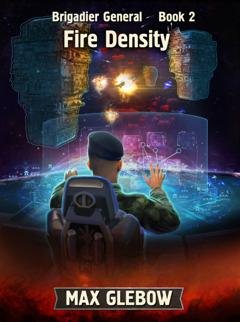
Max Glebow
Brigadier General. Fire Density
Prologue
“Kay, what’s up with the signal?” The Lieutenant gave a question that was of interest to everyone.
Shefferson has already been fiddling silently for two minutes with the direction-finder which he took out of his backpack, but, to all appearances, he hasn’t yet managed to achieve significant results worthy to be reported to his commander.
“I’m not getting anywhere. The quargs produce jamming, and their interference generator is not so far away, so they are blocking everything completely. With this much counteraction, we’ll hear the beacon at a distance of 500 meters at the best.”
The dropship made its turbines howl while pulling slowly from the ground and flew to the east above the hills towards the territory controlled by our troops. The plan was for it to find a safe place and wait for us to signal, and if thereʼs no signal within six hours, it has to arrive at a predetermined rendezvous point.
However, it didn’t work out. A bright flare and a noisy explosion right behind the hills, just 300 meters away informed us unequivocally that we no longer had transport to return to the base.
“Let’s go! Quick! ” The Lieutenant jumped up and and giving us an example ran to the nearest gorge between the sandy hills covered with burnt grass. Here and there hills were replaced by barkhans, the desert lay very close by.
Sergeant Ivan Kelt, deputy commander and our pathfinder, went ahead on the watch. I and the second universal commando, Private Gnezdoff, became flank security guards, and now we made our way almost along the top of the hills, trying to keep our heads down while carefully lifting the sensors of scanners just above the ridge. So far, no one’s been bothering us, but the tension has literally been in the air. The presence of the enemy was felt almost physically.
For half an hour we’ve been moving like this, trying to get away from the dropship crash site, and at the same time crossing the search area almost in the middle. The sense of imminent danger had eased slightly, and the Lieutenant gave the squad the signal to stop.
“Kay, let out your dragonflies, ʼcause we walk like we’re blind. It won’t take long to run into quargs.”
Shefferson pulled three small cylinder containers from the backpack, pressed the ends slightly in certain places, and dropped them into the air one by one. Containers turned out to be compact unmanned aerial vehicles. They unfolded like baby transformer toys, easily spread their thin wings and were hovering over the squad while quietly buzzing. Shefferson operated them with his helmet, at least I saw no special device in his hands.
The dragonflies flew in three directions, straight ahead and to the right and left at 45 degrees. We kept going, but almost immediately Kay stopped us. One of the dragonflies came across the remains of the scoutsʼ fly-car hit by quargs.
We didn’t move to the fly-car crash site. There was a high probability of an ambush there. Lieutenant with Shefferson went over the dragonfly camera footage. The information was distressing. The bodies of the four scouts lay not far from the wreckage of a smoking vehicle like broken dolls. There were eight guys who went out on a mission, which means there were at best four survivors. That is, if no one was left inside the demolished fly-car or died before. But the beacon didn’t work from here, or the dragonfly would have picked up itʼs signal. So someone managed to get away from the crash site. If only we knew in which direction.
The scanner built into my outfit was ringing the alarm. I’ve adjusted the different tone of the alert to different types of potential hazards and now, without even looking at the information appearing before my eyes, I already knew it was a quarg small recon drone. Single shot of my automatic gun echoed loud down the ravine and the wreckage of a small flying machine swept the hillsides. But we were undeniably discovered, and now the group is going to be hunted down and we haven’t even found any surviving scouts yet.
“Anton, you go a hundred meters down the ravine and stay here. Take the enemy away northeast. Go to the rendezvous point yourself, ” the Lieutenant assigned task to the universal commando Gnezdoff. “The rest follow me.”
“The dragonfly that came to the site of the fly-car’s fall is lost,” reported Shefferson. “Where to redirect the others, Commander?”
“Let’s have them look west. That’s where we’re going.”
“Got it. Doin’ it.”
Still, there’s a reason I spent a couple of days poking around with scanners and EW stations in the Academy tech area. And our tech Jeff was a big help. Results were not long in coming.
“Lieutenant, Sir, I’m picking up a beacon signal. Giving you the bearing.”
“Kay, can you confirm the Cadet’s information?” the Lieutenant turned to the regular communication specialist.
“Not yet, Commander. My direction-finder is silent.”
“Weʼre changing course. Ivan, take to the right, 15.”
“Yes, Sir.”
We went up a little higher and forward 40 meters.
“There’s a signal,” Shefferson reported with mistrustful surprise. “Cadet, what kind of scanner do you have in your gear?”
“Standard infantry scanner. But I’ve adjusted it a bit, and I’ve got a good tech, he helped me.”
“You’ve got a tech? What rank is he in?”
“A week ago he was a warrant officer. Now he is Lieutenant.”
“The warrant officer was given the rank of lieutenant? No school?”
“Put aside that blether,” the Lieutenant’s raised his voice on us.
“Yes, Sir,” Kay and I answered together.
We arrived at the beacon about 20 minutes later. It took us a while to find it. The beacon operated in short pulse mode at floating frequency. To hear it and to take its bearings, you had to know exactly what you were looking for. But again, the lack of a fixed signal made it difficult to find the beacon.
There were two scouts, a sergeant and a corporal, the latter was seriously injured when their fly-car fell. In the same time, he could really walk – exoskeleton is good for that.
“All right, so, fighters,” the Lieutenant called the scouts, “we found you, but we don’t know what’s next. We have no transport, our dropship has been knocked down by quargs. Thereʼs almost 400 kilometers in no man’s land from here to where we can signal our forces, and, more importantly, where they can safely retrieve us. There’s been a lot of quargs running around lately. Did you turn them on?”
“That’s right, Lieutenant, Sir,” said the Sergeant who introduced himself as Kimi Nukanen, “we went to their control zone and found a heavy robot deployment. Those were Mammoths of the latest model. No less than two divisions. It was in the middle of nowhere. Can you imagine how happy the command of our forces on heyn would be? That almost certainly means preparing for a ground offensive. And we, the naive ones, were waiting to be struck from space. Well, we were spotted on the exit. The quargs certainly did not wish to let such information leak. At first we got away, but we lost two of our own. We came at the fly-carʼs rendezvous point. You probably know the rest.”
“We know,” the Lieutenant nodded his head in agreement and started thinking. The subordinates waited silently for the commander’s decision.
“We go to the rendezvous point. Anton should be waiting for us there. The dropship, of course, will not come, but when we’re not back in time, they’ll send a drone. If we’re lucky, it’ll pick up and record our signal. If it can return to base after that, they’ll send a dropship, after us. Any questions?”
There were no questions.
“Then let the wounded go into the center of the column. Ivan – to the main patrol, Lavroff and Nukanen – to the sides. John, keep an eye on the rear. Kay, call off one of the dragonflies, we should save energy. For how long we’ll be here, no one knows. Go.”
Private Anton Gnezdoff never made it to the rendezvous point. Not the first day, nor the second. The drone did come, circled the dot, automatically responded that the signal had been received, and turned into a flash of bright flame from the impact of an enemy missile. And five minutes later, we were pinned down tight by a heavy infantry squad and a Small Dragon. Well, it looked like it was my turn to act.
We slowly retreated under the squeal of the shards and the roar of the Dragon’s automatic cannon constantly shooting our way out from every safe haven.
“Cadet, are you ready?” From the sound of the Lieutenant’s voice, there was doubt. He has already lost one universal commando, but Alexey was sure of Gnezdoff, and that guy must have done his job at the cost of his life. The Lieutenant didn’t know much about me, but he didn’t have any other options anyway.
“That’s right, Lieutenant, Sir. Which way to draw the enemy?”
“First, hold them here. Then lead around the rendezvous point. Give us an hour’s head start and leave. We’re gonna go east. We’ll try to get out on foot. We’ll turn on the beacon every four hours for ten minutes for you. ”
“I got it. I’m ready.”
“Good luck, Cadet. And thank you for the missile brought down. Well done.”
“Serving…”
“Put it aside, Lavroff. Squadron, follow me in the usual way. Go!”
And I was left alone.
The quargs didn’t get ahead. Either they were waiting for reinforcements or they weren’t feeling very confident, although their superiority of firepower was noticeable, even when our unit hasn’t split up yet. Now I had to play the whole group by myself.
Basically, with my equipment, I didn’t see anything impossible about it. My possession of three kinds of weapons made it possible to simulate different activities. That’s what I’ve been doing since I activated the second EW station in my spacesuit. This mode absorbed a lot of energy, but it’s become much harder to detect me with standard scanners. The Luyten-5 experience was very useful.
I fired three rounds from my automatic gun at the robot that stuck itself out in the open. I didn’t manage to penetrate it’s armor, but I spoiled his mood and forced him to hide behind a massive rock. Now it was time to change positions and wait a little bit, keeping my head down. My scanner picked up some questionable activity at the top of the hill, and I fired in a burst from the rotary machine gun on its crest without trying to hit anyone, but simply showing the enemy the presence of a shooter with a different weapon. Right after that, I stepped back and started to pick a position to work with a sniper rifle. The caliber of this rifle was, by the way, 18 millimeters, so only the Small Dragon pilot could feel relatively secure.
The alarmingly screeching scanner informed me that the quargs had launched a drone in my direction. They wanted to know where the shooters were, which was understandable. The drone was a small machine that didn’t fly fast, though it tried to hide in the folds of the area, briefly showing up from behind the rocks and the crests of the hills. It was almost a perfect target for a sniper rifle, especially if it was guided not by a man, but by computer-aided fire control. Shot, and the drone, which was broken through, fell to the ground as a pile of useless junk, but my position it marked and managed to transmit the information. The Small Dragon did not spare me a rocket, which was primarily intended to fire at air targets, but with a manual guidance, it was quite suitable for destroying enemies on the ground. My light armor was highly contraindicated to take direct hits or be in the vicinity of explosions of something heavy. So I jumped aside, made a roll and one more jump to the big rock, which took the brunt of the strike elements. I changed position once again…
I knew the quargs would soon get bored of this dance, and they would try to outflank the evil shooters. Except they’re not the only ones who can use drones, I love and respect these machines, too. On Luyten-5 I liked very much the black „cockroaches” of Captain Mbia, and I cadged three pieces from him. Little arthropod devices the size of mice have sprung up to the top of the nearest hills. Within line-of-sight range they were communicating with my suit through laser-optical channels and ignored virtually any interference. But now I saw what was going on in the back slopes of the nearest heights. I had a flying drone, too, but only one, and I decided to save it for the time being.
And in the back slopes, there was something interesting going on. Two quargs in heavy infantry armour moved gently along the ridge of the nearest hill, bypassing me on my right. There were another two on the left, and in front of me, distracting my attention, the combat robot was constantly bustling around, it kept popping out of hiding and shooting at me. The Small Dragon pilot wasn’t afraid of my gun, because from that distance it could only scratch the paint on his armor, well, maybe leave some small dents. Well, that was not a luxury fly-car. Scars like that are true decorations for a war machine.
There was an urgent need to resolve the problem of this bypass. Having fired my gun at random, not to hit someone or make the quargs hide, but to show them that I’m here and I’m not gone, I moved back and left. I moved pretty hard so I could get in the way of the couple of enemies that tried to bypass me, but keep out of their sight. I wasn’t going to kill them, I had another job to do. I need to slow down my pursuers, so I’ll hold them back. The bullet from a sniper rifle of my caliber, when hit in the limb, causes a serious wound, even if the enemy is in a heavy infantry space suit. After the shooting, I hid immediately, and watched the result with the help of the „cockroach”.
The result met my expectations. The unharmed quarg tried to pull the wounded from the battlefield, constantly staring and at any second expecting a new bullet from the invisible sniper. But the sniper kept quiet. I still didn’t shoot when the aggrieved couple got help from two more infantrymen under the cover of that Small Dragon with the slightly scratched paint on the armor. I was wondering where they were taking the wounded. They arrived here by something.
Using some specialized device, the quargs quickly placed the injured on the back of the robot, and the machine ran over the hill without losing any time. My „cockroaches” could not see that far, so I decided to risk the flying drone. I gave the miniature flyer an order to escort the robot, ordering it to keep a max distance from the target.
In the absence of the robot, the enemy infantry did not attack and kept quiet. I knew it wasn’t for long. I didn’t think they had their dropship far away, because they came at us pretty fast after our drone reached the rendezvous point. So I used the pause to break off the enemy and to get to the rendezvous point that I’d assigned to my flying scout.
The quarg dropship was within fifteen minutes of a careful and slow march. My opponents lost me and now they were probably trying to figure out where I got to, and where the main group went. According to my orders, I’ve been truthfully dragging the quargs up and down the hills for an hour. I was supposed to get back to the squadron, but it wasn’t my plan, at least now. I knew perfectly well that if I left now, I’d be at a dead end again. The power in the suit accumulators will soon be depleted. It wouldnʼt gonna be enough for a 400-kilometer walk in the desert. So, whatʼs next? To try to get out on foot, unarmed, and in just overalls? No. It’s better to risk doing something now.
I got to the dropship when the quargs were still shaking the hills and ravines in search of the missing enemy scouts. The robot ran to the aid of its infantry a long time ago, leaving the wounded in the care of the pilot and another quarg in the armor, who was assigned to the dropship apparently for security. Now the pilot was fiddling with the suit of the wounded quarg lying on the dropped ramp of the ship, and the guard was standing there, looking around.
Two dry clicks of my sniper rifle shots scattered across the hilly plain. The enemies sank down on the ground like weak puppets, but the signal of the attack on the dropship must have gone to the main group of quargs. Of course, I was hoping that my jammer wouldn’t let that signal get through, but the distance from which I fired did not let me be entirely certain, especially considering the fact that my position was not between the dropship and the main enemy forces, but on the side, otherwise I just wouldn’t see the target.
I ran without saving energy and squeezing maximum speed out of my gear. Every second could have been crucial. I didn’t kill the wounded quarg, just shoved him off the ramp with the pilot’s body and dived into the shadowy insides of the quarg dropship. I almost fell over a body in a space suit. That was a human space suite. Anton Gnezdoff was lying on the side of the ship and showed no sign of life. I saw a ragged hole in the chest plate of his armor, it looked like he was hit by a large shard. But the private was alive although unconscious. I couldn’t afford to look into his condition now and jumped further to the cockpit.
With the completion of operation at Luyten-5, I had quite a lot of time on my way back to Ganymede. Jeff and I had something to do. Remembering my adventures in a terribly uncomfortable quarg techʼs suit, I decided to throw away everything that had nothing to do with hacking enemy machines out of this suit. We mercilessly dismantled the armor, the weapons, the positioning and sighting system, the scanners and even the exoskeleton itself. So, as a result, it turned out to be a pretty compact device, which, if you wanted to, could be easily installed inside our human, heavy infantry space suit. And, of course, as I gathered up my equipment for this trip, I hadn’t forgotten about this device. The challenge was something else. I’ve never tried to hack a flying quarg machine, and all my knowledge of it was theoretical. But there was no other way, especially in light of the discovery of wounded Anton in the dropship.
I activated the equipment. Lucky for me, the dropship didn’t hide any surprises compared to combat robots. It was protected far worse than the Mammoths and even the Small Dragons, so, eight minutes later, I had the enemy machine in my hands. Except I’ve never flown one of these before. In a previous life, I did well piloting a small troop transport Cuirassier, in this life I piloted our dropship. But I’ve never had a quarg flying machine in my hands before. It was required to take immediate action, so I plunged without doubt into a mad picture, which the enemy vehicle’s targeting and navigation system projected on my helmetʼs visor. For taking off like this, our pilot instructor would have killed me if I were there, then he’d bring me back to life by means of a mighty kick in the ass and would kill me again. He would repeat the procedure until the necessary pedagogical effect was achieved.
The dropship was wobbling from side to side. I almost hit the nearest hill but only slightly grazed it and raised a cloud of sand. Nevertheless, I was flying. It was a good thing no one’s tried to shoot me yet. The machine I was flying was an easy target now.
At first I just flew away. Having realized that I can already, somehow or other, manage horizontal flight and careful maneuvering, I turned my attention to weapons. There were no thermobaric rocket launching containers that are so dear to the heart of any human commando. Instead, quargs suspended under one of the short wings an additional high-speed aircraft gun, and under the other wing – an air-to-air missile launcher with a laser-optical guidance system, which is used to follow the target manually. Looked like that was who shot on our planes and the dropship. Judging by the amount of missiles used up, I’d say it was so. The quargs knew we’d send a rescue team for the scouts. They flew in early, picked up a position, disguised the dropship, turned on the EW station, and quietly waited for guests. It was a perfectly sensible decision. But an evil brigadier general showed up and ruined the party. At least, let’s hope so.
I was no longer interested in the group of quargs running around the hills. I remembered there was still one missile left in the Small Dragon’s backpack, and at my level of piloting, meeting that missile didn’t seem like a good idea. I bypassed the threatened area along a wide arc, pressing the dropship belly against the hills, and even sometimes diving into the most spacious gorges. By my calculations, I’ve already beat Lieutenant Egorov’s team by ten kilometers. I didn’t risk arriving to them on an enemy dropship. They could just begin shooting before they can figure it out. Having landed the capricious machine in a small hollow, I went to the landing bay and squatted down in front of Anton. The quargs didn’t deactivate his suit. That’s all that kept the Private alive. The embedded first aid kit was doing what it could, but its prognosis was getting more and more threatening. If Gnezdoff isn’t in the hospital within the next five hours, there’s no way to save him. Which means we probably won’t have time to land in our control zone and call for help. I’m gonna have to brazenly fly the enemy machine right onto the runway of the special forcesʼ base. I donʼt think Iʼd be welcome…
I caught the beacon signal two hours later. I couldn’t waste time any more, so I took the dropship in the air.
* * *
A group that had already lost two people was moving east pretty vigorously. But it was OK just for now. There was still power left in the accumulators for another five hours. Lieutenant Egorov’s mood was getting worse by the minute. He didn’t see a real way out and led the group forward out of sheer stubbornness. Kay Shefferson raised his hand, urging the group to stop.
“Commander, I’ve picked up a drone, a human one. But this is not my dragonfly, it’s something else.”
Soon they saw the device. It slowly approached, circled the group with a slight buzzing and withdrew behind the ridge of the nearest hill.
“John, look what it is,” ordered Alexey.
The sniper went up the hill, raised an optical scanner over its ridge, and then he went straight down to the squad.
“There’s a quarg dropship, Commander. It’s on the ground, the ramp is open, and near it stands our Cadet in his ‘barn’ with guns. He waved at me.”
“Are you not overheated, John? Send me the file.”
When the Lieutenant started playing it, he looked for a few seconds into the image projected onto the helmet visor, then silently slapped the sniper on the shoulder, made a sign to the subordinates to follow and climbed the hill.
* * *
Major Weber was pulled from the table by the howl of an air-raid warning.
“Duty Officer, report!” ordered the Major via communicator.
“An enemy dropship has entered the control zone.”
“Alone? No cover?”
“That’s right. Altitude is one kilometer. It flies slowly. Doesn’t maneuver. It makes an ideal target.”
“Wait, Lieutenant. Something’s wrong here. I’ve never noticed quarg suicidal tendencies before.”
“It could be a diversion, or it could be a simulator.”
“Put the battalion on combat alert. Make air defence equipment fully operational. The dropship can launch missiles from ten kilometers. How far is it now?”
“105. If it doesn’t change speed, it’ll enter the firing range in fifteen minutes.”
“Call the interceptors.”
“Yes, Sir!… Major, Sir! There’s a signal from the dropship! It’s unstable yet. I can’t make it out. But the coding is ours.”
“What the hell?.. Turn it on me.”
The Major’s office was filled with cracking noise through which sometimes incoherent pieces of words burst. But with each passing minute, the distance decreased and the quality of the communication improved.
“…ship calls… …ber Dropship… Major Weber. …tenant Egorov’s group returns from mis… Pri… seriously wounded. Request emergency evacuation to hospi… ”
“Scheißer! Don’t shoot!” shouted the Major via communicator. “Call back the interceptors! Get medics and emergency crew on the runway right away. ”
* * *
“Major, Sir, have you sent Cadet Lavroff back to Academy?”
“Yes, I have, Lieutenant. He earned the low-level combat experience he needed in one mission abundantly. His practice ended there, so the Cadet left. And he took the dropship with him as a legal trophy. I didn’t mind. ”
“That’s a pity, I had no time to talk to him. You have introduced me to the promotion. I’d be happy to give him my group, with a completely calm conscience. When he finishes his studies, naturally.”
“You’re still a rookie, Lieutenant,” Webber laughed so hard, “Haven’t you read his file?”
“At first, there was no time,” Lieutenant was embarrassed, “And then there was no need. It just became clear what a man was worth.”
“Would you at least look out of curiosity,” squeezed the Major out of laughter, “Who did you want to offer the group to? This Cadet of yours had been commanding a Heavy Commando Brigade for a month on the quargs-occupied Luyten-5. Generals are certainly waiting for him to graduate from the Academy, the Generals with such shoulder straps that you and I are very far away. Well, Lieutenant. It’s been a long time since I’ve had this much fun.”
Chapter 1
The front didn’t collapse, but it cracked quite a bit. As it turned out later, this was the first, but very bad, wake-up call that marked a difficult time for people. A distracting quarg strike on the Luyten’s system caused the Earth Federation to react sharply, and draw on significant reserves to address the threat. As a result, it was almost impossible to counterbalance a strong and unexpected blow in the other direction – it was an attack on the Federation planets of stars Gliese-338 and Groombridge-1618. This led to a serious defence crisis, which the people were unable to overcome quickly.
When I returned to the Academy, the high command was in a very nervous state. Reserves have been raked out wherever it’s been possible, and Lieutenant General Schiller had to reluctantly agree to the early graduation of third-year cadets. As it happens in such cases those cadets received only one star on their shoulder straps instead of two and the rank of second lieutenant, which was rare in the army. Suddenly I was out of the job as an instructor, since it was the graduate course of the Academy that mastered the captured machines.
Academy director called me back to his office. When I tried to report, he waved it away annoyingly and silently pointed me to the meeting table.
“Cadet Lavroff, ” began gloomily the General, whose mood fluctuated at the mark „below the skirting board”, “you’ve certainly done a great job, and you are a hero. Colonel Kreps sent me Major Weber’s report on your practice. For your rescue mission, he recommended you for the Iron Cross. We, Germans, prefer to recommend deserving soldiers for precisely this award.” A light shadow of smile appeared on the General’s gloomy face. “Kreps approved the recommendation, punch a hole in the tunic.”
“Serving the Earth Federation.”
“Ehh, yes. And you serve it pretty good. Except with the situation on the front… Do you know, Lavroff, when was the last time we had to throw undertrained cadets into battle?” Forced to sign the order for the early graduation of the third course the General couldn’t calm down.
“That was in the first year of the was with quargs, General, Sir.”
“That’s it. Twenty years ago. Do you understand where we have returned?”
“These are temporary difficulties caused by the strategic error and intelligence deficiencies. We shall undoubtedly prevail, Gen… ”
“Put ranks aside, Cadet. ”
“Yes, Sir.”
“You’re right! The recon guys have overslept, to put it mildly, preparations for strikes on Gliese and Groombridge. And right you are about the Luyten’s system – too much force was thrown in there, although this mistake may have saved the lives of you personally and of our freshmen.”
“Not of all of them, unfortunately.”
“Not of all of them. This is war, Cadet, you know it as good as me, or better yet, I haven’t been in a fight in a while. And that’s the second question I want to discuss with you. We’ve already lost almost half our freshmen and we’ve lost the opportunity to prepare well our graduates. I wouldn’t be surprised if they cut the curriculum down to two years. Now freshmen, your comrades, are better prepared for battle than sophomore cadets, and, probably better than those fresh second lieutenants who have just been graduates. I need practical advice based on your combat experience. I have to turn the remaining cadets into officers who will not be killed in the first battle with their units. Don’t look at me with wild eyes. Yes, the General asks the Cadet to share his combat experience. Have you recently looked in the mirror at your qualification tab?”
“I can tell you one thing, if it wasn’t for the six months we spent at the Academy, none of us would have come back from Luyten-5. When our ship was hit by several shells and began to drift uncontrollably towards the planet, the cadets remained a capable military formation despite the deaths of the officers. The platoon commanders did not lose control of their subordinates, and as a result, the landing took place with minimal casualties. You’ve prepared us well, Lieutenant General, Sir. What we had frankly missed was heavy weaponry and experience of guerrilla activities and sabotage. If it wasn’t for Captain Mbia’s men, I don’t know how we’d get away with it. I’m afraid that in the new circumstances commandos will be regularly caught in such situations of complete encirclement and isolation from the main forces. We need knowledge in this sphere and reconnaissance equipment. I’ve been meaning to report my proposals to establish a special recon platoon equipped as regular scouts in each commando battalion, but since you called me yourself, I’d like to take this opportunity.”
“Usually, scouts are assigned to commandos at the time of landing, if the command deems it necessary. Your case was special. No one was planning on sending you into battle, so you had to work it out on your own. I do not yet see arguments in favor of a special platoon in each battalion.”
“You told us yourself that a saboteur and a commando are different military specialties. From Captain Mbia’s men, I’m very well aware of that. They’re good scouts, but they’re not first line fighters. They can’t be sent to attack. They just don’t have the training and equipment for this kind of battle, and I was desperately short of men on Luyten-5 who could attack in the regimental order of battle, and then, if necessary, become saboteurs. Everyone in the landing party has to fight. This rule has been known since pre-Cosmic times,” here again it’s been far-fetched from the experience of my past life.
“Well, that makes sense,” said the General after a moment of reflection. “Prepare a report, Cadet, I’ll review it, and maybe I’ll give it a go. And now I have news for you. Yesterday at the Academy’s board of trustees meeting we talked about you. The Chairman of the Council, General of the Army Vasnetsov joked that we have cadets in the Academy with sufficient combat experience to enter the General Staff Academy. Laugh all you want, but after the meeting I pulled your file. You’re a ready candidate for the Academy. You’ve had enough experience in command positions. The only thing you need is a higher military education, and only officers are allowed in the Academy. You’re 16 now, as strange as it sounds. I keep getting the feeling that I’m dealing with someone my own age, but from a formal point of view, it doesn’t change the case. You’ve done enough for the Academy to make its director in my person want to take part in your destiny,” grinned the General, “but the only person in the Earth Federation who can authorize officer promotion circumventing the age limit is the President. I’ve spoken to Vasnetsov, and he’s ready to make a presentation to the President for you to be promoted to the rank of second lieutenant. I’ll sign the recommendation, too. We need the signatures of three other high-ranking officers who know you personally and can vouch for you. Do you have an idea?”
“Colonel General Knyazev, Admiral Nelson, Admiral Fulton,“ without hesitation I listed,”I really don’t know Admiral Nelson personally, but he commanded the operation to free Luyten-5, and I think the Colonel General can persuade him to sign this document.
“You didn’t waste any time,” grinned the General, “Fulton and Knyazev can’t stand each other. To the extent that this is known well beyond the Fifth Strike Fleet. If you manage to collect both these signatures on the same document… Okay, enough of this stuff. Let’s start, perhaps, with Knyazev.”
* * *
We fought off the quarg attack at the cost of losing the Gliese-338 system and almost complete destruction of the infrastructure in Groombridge 1618, but the enemy’s advance was stopped. The early graduates were even sent back to the Academy to finish their studies. A little over a quarter of those who left the Planetary Commando Academy 40 days ago have returned.
For the next four months, I worked like wood-carver Geppetto on the Pinocchios’ assembly line. The director of the Academy had drawn up a plan for me to crash into my wretched head and the motor centers of the spinal cord the knowledge of all specialized subjects for which the cadets were normally given two and a half years of learning. I was handling it, but I sank into bed in the evening like a sack of potatoes and fell into a dead sleep until the morning. And then I was called to the capital, to Earth, to be awarded the Gold Star.
I didn’t like the situation on the front lines. When I came here, the balance of opposing forces seemed steady, and I thought I had at least five years left to get promoted and to make useful connections and improve my abilities. Now I realized clearly that if I wouldn’t act now, The Earth Federation risked losing the war before I can complete my mission. It was time to put a team together. I wouldn’t manage to do this alone.
Once again, as the first day of my life in this world, I decided to analyze my assets and liabilities. The task of constructing the portal gates so far was as unattainable as when I arrived at the hospital on Titan. I saw no direct and quick way to solve it. Well, let’s take advantage of the way that’s as old as the world, and divide a big problem into a lot of little pieces. I need the knowledge, resources, people and permission of the authorities to build and test the gate. I have the knowledge. But it’s not exactly the kind of knowledge I need. I won’t build the gate myself, which means the information in my head needs to be legitimized. How to do that? The cadet and even the second lieutenant, if the response to the submission is positive, don’t have that kind of knowledge. So what we need is an official organization that can present this information as its own development. That’s number one. Now regarding the resourses. At the moment it’s primarily money. Right now, my personal account contains just over 32,000,000 federal rubles. These are patent royalties, instructor’s wages, trophy prizes and gratuities attached to the Iron Cross and Gold Star. That seems to be quite a lot. With this money, one can comfortably live in the capital of the Federation for almost ten years. But it concerns a common man. I’m a person who’s very restless and unprepared to just sit on his ass, so this money will be enough only for a start. So, the question of resources is soon to be resolved, but not right now. That’s number two. Next on my list are people. I’m supposed to pursue a career in the army where I’m not even an officer yet. So, all the current affairs of providing resources and the activities of the company yet to be created will have to be handled by someone else. I mean, sure, I’m gonna go for it, but I might not have the time or the opportunity. I started thinking and almost immediately remembered Lieutenant Jeff, my senior technician. He should be interviewed one of the first. Professor Stein of The Colonial Technological Institute may also be of use. His name and connections will certainly prove useful. And I need to talk to Inga. I could really use a trusted person at the company. To be honest, I really wanted her to give up her military career, but knowing her, I was kind of afraid to even talk about it.
So, basically, the plan has been ready. First, a weapons development firm. It’ll help me solve two problems at once. I will slowly feed my knowledge from the past life into it and embed it into new weapons samples, thereby legalizing the information I need. And money, of course. The development of the gate will require just an enormous amount of money, which the Federation treasury would never give me, and that way I’ll spend the company’s profits. The second, no less important than the first, is the military career. By the time the gate is built, I must have sufficient influence in the authorities to provide the contact of civilizations according to my scenario. And third, it’s time to help the Federation with new technologies, otherwise we may not live to fulfill that contact.
* * *
The capital of the Earth Federation, the huge city of Amundsen, is located at the south pole of the planet, in the heart of Antarctica, covered with forests. In the middle of the twenty-first century, the human race here finally succeeded in contaminating the home planet, with irreversible environmental consequences. Waste islands in the oceans, man-made disasters on oil platforms and chemical plants, oxidation of ocean waters with carbon dioxide, filling the atmosphere with dust and its poisoning combined with the increasing overpopulation of the planet, all of this has led to people barely surviving to develop terraforming technologies. And the first planet to which terraforming had to be applied was the Earth itself.
An artificial thermonuclear sun hung above the south pole, melting the ice and giving to the suffocating and thirsty mankind source of fresh water and oxygen extracted from it. This seemed to be a temporary solution, but it allowed people to survive to the point where the deep purification plants built along the air and sea currents would bring the concentration of harmful substances in the atmosphere and oceans to an acceptable level. Humanity no longer made such mistakes, and the environmental protection began to be treated on the Earth with blatant fanaticism. Not surprisingly, the ice-free southern continent has become a forest-and lake-covered paradise, in the middle of which humanity, grateful for its salvation, has jointly built an ecologically exemplary mega-city which became the capital of the Federation.
There was a spring in the southern hemisphere of the Earth, and the Antarctic sun also imitated this pleasant season. The awards ceremony was two days away, and since I was in the capital, I decided to take care of my future corporation. I didn’t know much about local law, so I went to a small consulting firm I found online, whose pages seemed adequate to me.
“Good afternoon, I am the leading lawyer of „JurTex” Leo Rabinovich,” the man who answered my call was a vibrant man in his 30s, “What can our company do for you?”
“Igor Lavroff,” I said in return, “I need to register a company that will be able to take part in the State procurement competition.”
“Sphere of activity?”
“Development and supply of weapons and military equipment.”
Rabinovich had a glimpse of surprise, but he kept on talking calmly:
“This activity requires State licensing. The list of requirements for obtaining a licence is extensive. There is a need for a production base, qualified staff, minimum registered capital requirements.”
“That’s why I asked for your advice.”
“Tell me, Igor, do you plan to become the founder and owner of the company?”
“No. I’m a minor. My mother will own the company.”
“How much are you planning to invest in the capital of the new organization?”
“30,000,000 rubles.”
Rabinovich didn’t give a damn. None of his business where a 16-year-old boy took that money. Maybe he’s the son of a wealthy businessman, maybe it’s an inheritance. Who cares?
“Well, that’s enough, at least, to comply with the law. I can take your case, but to obtain a license for such an activity I need from you a number of documents, which confirm that you have experience in the development of new weapons, as well as the results of tests of your products and recommendations from high-ranking military officers. Are you able to provide them?” in the eyes of the lawyer there was doubt.
“I think so. But it’s gonna take some time.”
“Then we can do this: I’ll register a company for you. This will be the first stage of our cooperation, a rather inexpensive one. Next, as you provide the necessary documents, we will proceed to obtain a license. Here, prepare the money, Igor. It will not cost you less than half a million rubles.”
* * *
The rewarding ceremony was very solemn. 35 persons to be awarded were assembled in the main column hall. The award was broadcast online throughout the Federation. In addition to the President, there were many high-ranking officials and military officers. I was licking my lips in anticipation while looking at this flower garden of potentialities, but my insignificant rank has isolated me from them as well as thick tank armor. Earth Federation President, Marshal Ivan Tobolsky, 60-year-old impressionable man with a thick mane of gray hair, a nose with a light hump, a strong chin and piercing brown eyes, delivered a speech that was traditional for such cases, but was slightly adapted to the current situation on the fronts, which was by no means the best. Therefore, we’ve heard repeatedly: «in this difficult time», «it is time for hard tests» and «verification of our will to win». And then he went straight to the award. A tall and smooth general who summoned my association with the word ‘parquet’ gave the name of the next recipient, and the guy in question approached the President with a report while marching in a ceremonial pace. Most of the time Tobolsky smiled habitually, took the award from a tray his extremely solemn assistant was holding, handed it to the hero and shook his hand with congratulations. The decorated man responded with a statutory phrase and returned to the line. Sometimes the President spoke to the officer or soldier a few words in a quiet voice and even listened to the answer. It was impossible to understand exactly what they were saying.
I turned out to be one of the last.
“Commander in Chief, Sir, Cadet of the Planetary Commando Academy Igor Lavroff has arrived for the state award!” I reported clearly to the President.
“Luyten-5? Commanding the Heavy Commando Brigade and striking to meet our landing party?” suddenly asked Tobolsky. There was a glimpse of surprise on the face of the foppish general who heard the question.
“That’s right, Commander in Chief, Sir.”
“Congratulations on the Order of the Gold Star, Second Lieutenant. And on joining the General Staff Academy. Now more than ever, we need such commanders.”
“Serving the Earth Federation,” I answered according the regulations, standing at attention.
“Unique Specialist?” The President quietly asked, nodding at the badge on my tunic and having thrown the ceremonial General into final shock by deviating from protocol. “Do you have any requests or suggestions?”
I, too, was barely keeping my face cool, but I wasn’t going to miss an opportunity like this.
“That’s right, Commander in Chief, Sir. I do.”
“After the ceremony wait for my assistant. And now you’re free to go, Second Lieutenant.”
There was no miracle, no personal meeting with the President, but his assistant did find me after the awards ceremony, and diligently concealing his disdain for a person as insignificant as a second lieutenant, invited me to submit my requests and views in writing and send it to him for processing and transmission to the Commander in Chief.
* * *
The door to the President’s office opened silently and the well trained assistant brought the Head of State coffee and ginger cookies. Tobolsky silently nodded.
“Mr. President, you asked me to remind you of Second Lieutenant Lavroff. ”
“Ah, Lavroff. Yes, thank you,” – Tobolsky wearily moved his hand along his face. “What’s there? Just briefly.”
“He claims that in the operations on Luyten-5 and Kapteyn, he used weapon systems of his own design, based on our and trophy circuitry and built on the Academy tech base and in the field conditions. According to him, they were far more effective in combat than our standard models.”
“Did you check that?”
“Yes, Mr. President, I’ve sent inquiries to his commanding officers. The answers have been strictly positive. In the case of Luyten-5, there is even a specific combat efficiency calculation: 130 percent.”
“Hmm. Let’s say it’s OK. What does he want? Money for development or transfer to a defense industrial complex?”
“Oddly enough, no. He doesn’t ask for money and only sees himself in combat units. He requests a licence to develop arms and military equipment for a company he has just registered as well as unhindered access to the Ministry of Defence competitions.”
“What’s the problem with the license?”
“It has been the practice of the Ministry of Defence to issue such licences only to large enterprises within the defence industry complex and to their subsidiaries. There’s no way for a small firm just set up to get a license like this. They just won’t let you, even after fulfilling the formal requirements. I mean, there’s so many of them, you can always pick on something.”
“Let’s not get in his way. This guy might be useful to us. Someone in the Military Industrial Complex has overdone things, and this guy, if he doesn’t turn out to be nothing, which I don’t think he will be, could be a good pain in the ass… What is required of me? ”
“Recommending a license with your signature will solve all the problems.”
“Is draft paper ready?”
“Yes, Mr. President.”
“Send it to me, I’ll sign it. And let me know if he makes any sense.”
* * *
Leo Rabinovich froze up, staring at the screen of his tablet. I understood him well. I sat like that yesterday, stupidly reading and rereading the recommendation to issue the Lavroff Weapons Company a license to develop arms and military equipment, signed personally by President Tobolsky.
Finally, the lawyer stopped scrutinizing the document and gave me a still slightly stunned look.
“I think, Igor, in a week you’ll be licensed. With such a recommendation, it is unlikely that anyone would pay attention to formalities, because, in fact, Mr President himself has assumed full responsibility. You’ve earned a lot of trust, though.”
I just hemmed vaguely. I didn’t expect it myself. And some little worm of doubt was scratching somewhere in my brain, banging hammers into the top of my head: there’s no free cheese in rat labyrinths.
“I’m more than happy with the week,” I told Rabinovich, “But I have to get started somewhere. Can your company find me an office space and an experimental workshops site?”
“I think so. It won’t be a problem. It’s not hard to rent an office in the capital, if one has money. It’s pretty simple with a production site, but not on Earth, of course. There’s no way you’re gonna be allowed to set up a production site here, but the Moon is at your complete disposal. There are huge tech parks where they will be happy to rent you out the necessary space, perhaps even together with the equipment.”
“Then, Leo, get the list of the parameters of the site and the office that I need, and I’m looking for suggestions.”
* * *
“Good afternoon, Ivan Gerkhardovich,” I decided not to delay calling Professor Stein,“Do you have a few minutes for me?”
“Glad to see you, Igor,” the professor gave me a sincere smile. Of course, I’m the one he has extremely positive memories with, both emotionally and financially, “Always happy to talk to you. But you didn’t just bring up the provincial professor. Surely you have another adventure for me. Am I right?”
“As always, Ivan Gerkhardovich, as always,” I didn’t deny it, “But I’m also very happy to see you in a good mood.”
“Well, tell me, then. Why waste time?”
“I’ve registered a company and I’m going to develop weapons for our army. In a week’s time, I’ll have the necessary license, office and space to house the production equipment. I need people, good engineers and scientists to develop EW systems, armor and cannons, and then utilize all this into prototypes of spacesuits, dropships and combat robots. Ten people will be enough for now. I’ll send you a list of the skills needed. Could you find me such people among the best students of the Colonial Technological Institute or among recent graduates? I need young people with open-minded brains capable of perceiving and developing breakthrough ideas.”
“Give me your list, I’ll see what I can do.”
I sent the professor a pre-prepared paper. A couple of minutes later, Stein stopped reading and looked up at me.
“I think I will. I see you’ve already indicated the approximate salary levels. I don’t think any of my candidates would give up on that. It’ll take me a few days to talk to the right people.”
“Thank you, professor, I had no doubt that you could help me recruit people. But that is not all,” I said, observing a slight surprise and interest on Stein’s face,“To manage this team, I need an experienced leader with the necessary knowledge and authority in the scientific community.”
“And you want me to help you find such a man?”
“No, Ivan Gerkhardovich, I don’t. I already found him. This man is you. If you want to, of course. But something tells me you’re not gonna say no,” I smiled rapaciously.
The professor started thinking. He didn’t see it coming.
“Hmm,” Stein vaguely hemmed, “about another adventure, I did guess. I’d probably send someone else with that idea a long way away. I’m too used to the Colonial Technological Institute, I’ve got all my roots in it.”